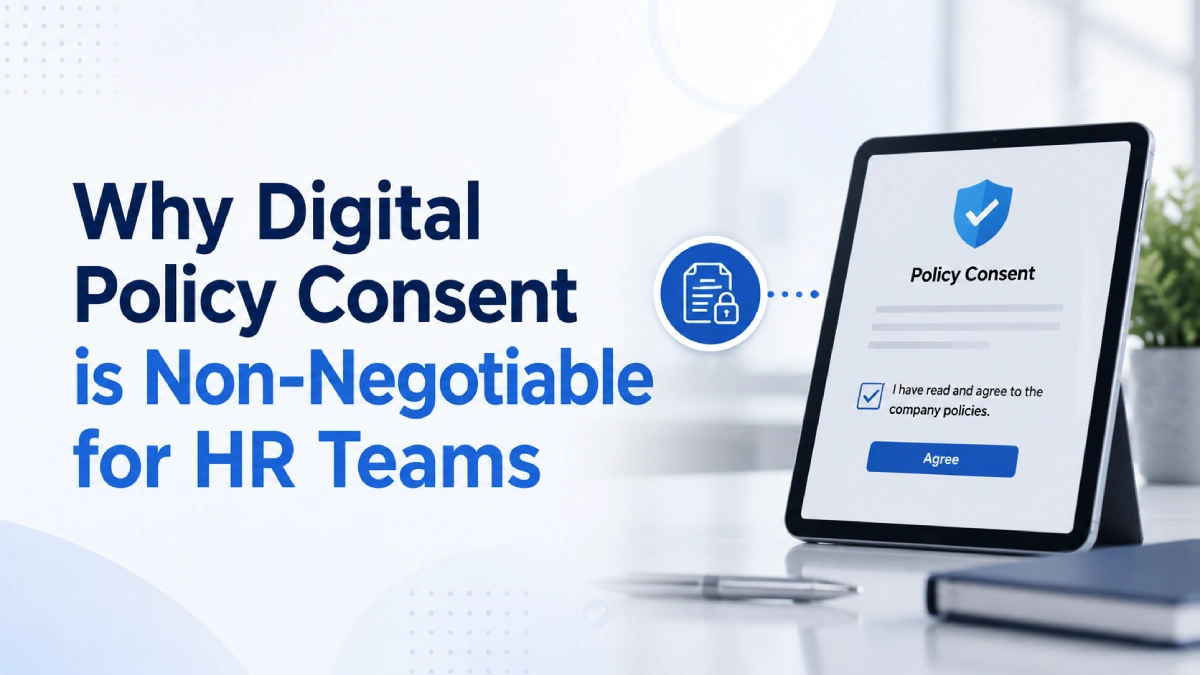
Nobody's morning coffee is usually accompanied by thoughts of policy acknowledgment forms. You've got hiring, performance reviews, and a million other things demanding your attention. Policy consent often gets pushed to the back burner, waiting for its moment.
Suppose you've had a series of discussions with an employee about his repeated violations of your company's crucial data security policies. After careful consideration, a termination decision seems like the only logical and necessary course of action to protect your organization. You proceed with the termination, believing the process was sound.
Then, without any forewarning, the situation takes a critical turn. The employee, instead of accepting the outcome, initiates a legal action against you, claiming wrongful termination. His argument is that he never agreed to the policy and he never even signed it. Suddenly, what appeared to be a concluded matter transforms into a potential legal dispute.
This uncomfortable reality, one that many HR professionals might hesitate to voice, comes to light: in a surprising number of organizations, the employee's assertion can hold significant weight. This isn't because the policy itself didn't exist. It's because its existence is fundamentally different from its effective communication. A policy confined to a handbook that goes unread, or buried within a welcome email alongside ancillary documents simply cannot be considered adequately communicated. Here employee handbook digital sign off plays an important role.
Bridging the Gap: Understanding Why Employees Miss Your Policies
Here's a thought-provoking point: when employees claim they weren't informed about a policy, they're frequently being truthful.
It's a tough statistic, but 66% of HR professionals find it challenging to get employees to read the employee handbook. We're not talking about just signing it or quoting it; we mean actually reading it.
Yet, many organizations distribute it once during onboarding and consider the communication complete.
The rise of remote and hybrid work has only complicated this. A 2023 SHRM survey revealed that 40% of HR professionals are concerned about policy enforceability with distributed teams. This concern is understandable; the very way policies are written often creates a barrier. They can be dense, formatted more for compliance audits than for easy human comprehension, buried deep within an intranet, or sent as PDF attachments in welcome emails along with numerous other onboarding documents. Let's be honest, nobody enjoys reading those.
For teams managing remote workforces in India specifically, this guide on attendance management and remote work policy is a vital companion read it explores these exact practical tensions within the unique context of Indian labor expectations and remote logistics.
So, the issue is of not malicious intent from employees. Instead, it stems from broken distribution methods. And it's precisely this gap that can unfortunately surface and cause significant problems for HR when issues arise. To overcome these manual tasks, a HRMS with policy consent module will help you better.
What Happens When Proof Goes Missing?
Let's get down to the nitty-gritty – the part that might make HR folks a little uneasy.
When a policy disagreement ends up in a labor court or an internal review, the key question isn't if the policy existed. It's whether you can demonstrate that a specific employee received, understood, and agreed to it.
And if you can't provide that proof? Well, here's what unfolds:
Your Defense Crumbles: Without a signed acknowledgment, a digital timestamp, or any kind of audit trail, your entire case often boils down to a simple "we think we sent it." That's not a strong legal argument.
Disciplinary Actions Backfire: Warnings, terminations, or performance improvement plans can be easily challenged if the foundational policy hasn't been verifiably communicated. Labor courts, both in India and globally, generally place the burden of proof squarely on the employer.
Trust Takes a Hit: When an employee states, "I was never told," and HR can't counter that with solid proof, everyone loses then. Management may start second-guessing HR's processes, and the employee can feel unfairly cornered.
Audits Highlight the Weak Spots: Internal and external compliance audits, especially in industries dealing with sensitive data, will require records of policy acknowledgments. Lacking these under regulations like India's Digital Personal Data Protection (DPDP) Act and similar global frameworks, can lead to significant penalties.
There's a reason why IT and BPO labor tribunal cases in India increasingly hinge on HR's ability to present documented proof of policy communication.
The cases where companies falter – resulting in back pay, forced reinstatements, and reputational damage – almost invariably share one common factor: the absence of a clear acknowledgment record.
The US Department of Labor issued over $26 million in employer fines in just one year, and India's regulatory landscape is moving in a similar, increasingly stringent direction. This isn't a problem for the distant future; it's a pressing current issue.
And if you are managing a multigenerational team- which is highly likely these days – the challenge becomes even more complex. Different generations interact with digital policies in very distinct ways. For a deeper dive into this context, this guide on managing multigenerational workforces is a valuable resource.
So, What Does "Good" Employee Consent Management Look Like?
The great news is that fixing this isn't rocket science- it just requires being deliberate about it.
When done right, digital policy consent HR isn't about forcing employees to click through yet another form they'll forget immediately. It's about creating a clear, reliable record that accurately reflects what happened: this specific person, on this specific date, received this specific version of a policy and confirmed it.
Here’s what that looks like in action:
Timestamped Delivery Receipts: The system automatically logs exactly when a policy was sent and to whom. Forget "we think we sent it in March"; it's precise: "sent on March 15th at 10:03 AM to Jane Doe."
Active Acknowledgment Flows: Instead of a PDF that often gets downloaded and then ignored, the employee is guided through a process to confirm they've read and understood the policy. This Digital HR Policy acknowledgement turns passive receipt into a documented agreement.
Audit Trails with User IDs: Every single acknowledgment is linked to a specific employee and the exact policy version they agreed to. If a dispute ever arises, you have a clean, easily retrievable record ready to go.
Smart Version Control: When a policy is updated, the system automatically triggers a new acknowledgment request for that updated version. This means no one can claim they weren't informed about the latest changes.
Automated Follow-Ups: Employees who haven't responded are automatically flagged and receive nudges, taking the manual chase work off HR's plate. The system helps maintain accountability.
A Quick Checklist to See Where You Stand 📝
Let's take a moment to audit your current system. Go through this checklist:
✅ Digital Delivery & Active Confirmation: Are policies sent digitally with a required "read and confirm" step, not just as a simple email attachment?
✅ Unique Timestamps: Does each policy acknowledgment have a unique, specific timestamp for each employee and for each policy version?
✅ Automated Reminders: Do automated reminders go out to employees who haven't responded within a defined timeframe?
✅ Secure & Accessible Audit Logs: Are audit logs stored securely and retrievable quickly, rather than being buried in a general shared drive?
✅ New Hire Onboarding: Do new hires receive and acknowledge policies as an integral part of their onboarding, not days or weeks later?
✅ Automatic Update Cycles: Do policy updates automatically trigger a fresh acknowledgment process for all relevant employees?
Any box you can't confidently check indicates an area that needs attention. It's much better to identify these gaps now than when a problem arises.
Bottom Line.
When an employee says, "I was never told about that policy," your confident, evidence-backed answer should be "Yes, you were." And the best part is you'll have the timestamped proof to back it up.
That's the core benefit of HR digital policy consent. It's not about creating more paperwork for the sake of it. It's about implementing a system that ensures you're always prepared with irrefutable proof precisely when you need it most.
If you are also looking for an application for digital employee policy acknowledgement in India, explore ZENFLOW HR and see how it streamlines policy tracking, distribution, and consent documentation- from Day 1 onboarding all the way through every single policy update.
FAQs
1. What's the difference between a policy existing and being communicated?
Think of it like this: a policy exists when it's written down and stored somewhere, maybe in a handbook or an intranet. But it's communicated when an employee actually receives it, has a chance to read it, and formally acknowledges that they understand it. A policy hidden away or sent as one of many documents in an email isn't truly communicated.
2. Can digital policy consent really prevent legal disputes?
While it can't guarantee you'll never face a dispute, strong digital consent processes significantly reduce your risk. By having clear, timestamped records of employees acknowledging specific policy versions, you build a robust defense. This documented proof is crucial in labor tribunals and audits, showing that you took proactive steps to inform your team.
3. How can I make sure my policies are actually communicated, not just sent?
Focus on active acknowledgment. Instead of just emailing a PDF, use a system where employees have to actively confirm they've read and understood the policy. Ensure there's a clear audit trail for each acknowledgment, a system for version control when policies update, and automated reminders for those who haven't responded. This turns a passive delivery into a documented agreement.
4. How to get employee consent for HR policies digitally?
Getting digital consent is simpler than most companies think. Here's the process:
Upload your policy documents- leave rules, code of conduct, NDA into your HR system. Assign them to relevant employees by department, role, or joining date. The system notifies employees via mobile app or email to review and acknowledge.
The employee reads the policy and clicks to confirm. That confirmation is instantly recorded with their name, timestamp, and device details, creating a tamper-proof audit trail.
HR gets a live dashboard showing who has acknowledged and who hasn't. Automatic reminders follow up with pending employees. No manual chasing needed. If someone still doesn't respond- the system escalates to their manager automatically.
The result? Every employee was informed. Every consent is documented. Every record retrievable in seconds- whenever you need it.
5. How to document employee policy consent?
Proper consent documentation goes beyond collecting a signature. Every consent record captures employee details, Policy name and version, Timestamp, mode of consent and Device and IP details.
Store all records in a centralised HR system- not email threads or shared drives. Records should be tamper-proof, access-controlled, and exportable for audits or legal proceedings.
Update consent when policies change. A record of an old version doesn't protect you against disputes about a new one. Every policy update should trigger fresh consent from all employees.
Retain consent records for a minimum of 3 years post-exit- longer for policies related to data privacy, harassment, or financial conduct.

Comments (0)
No comments yet. Be the first to share your thoughts!
Sign in to leave a comment
Sign In